
Does Your Business Need an Online Store, or Just a Website?
Only if customers are ready to buy without talking to you, and you are ready to run what comes after the checkout: payments, stock, shipping, returns and questions. If most sales start with a conversation, a catalogue with an easy enquiry may serve you better for now.
- For
- Growing
- Published
- Reading
- 4 minutes
- By
- Aeterna Works
When a small brand starts to grow, an online store looks like the obvious next step. Customers can buy at any hour, from anywhere, without a message back and forth. For some businesses it is exactly right. For others, it adds work and cost before it adds sales.
The question is not whether online shopping is popular. It is whether your customers buy the way a shop expects them to, and whether your business is ready to run what happens after the checkout.
Three questions before you build a shop
Do your customers buy without talking to you? If most sales start with a question about size, timing, customisation or delivery, a checkout button skips the part of the sale that matters. If customers already know what they want and just need a way to pay, a shop fits.
Are your products standard or made to order? A shop works best with clear products: fixed sizes, fixed prices, stock you can count. Made-to-order work, bespoke pieces and large orders often need a conversation and a quote first.
Can you handle orders every day? A shop is open all the time. Someone has to check orders, pack them, answer questions and handle returns. If that person is you, alongside everything else, plan for it before you launch.
What a shop involves after launch
Building the store is the visible part. Running it is the larger part. Before choosing a shop, be ready for:
- Payments. An account with a payment provider, its fees on every sale, and payouts to your bank. Check which providers work in your country and currency before anything else.
- Shipping. Rates, zones, packaging and a courier, and a clear answer to "how long will it take?"
- Stock. Keeping the numbers on the site in line with what is on the shelf.
- Product content. Photographs, descriptions, sizes and prices for every item, kept up to date.
- Policies. Returns, refunds, delivery times and privacy, written down and easy to find.
- Customer service. Answering questions before and after the sale, often on more than one channel.
None of this is a reason not to sell online. It is a reason to decide with your eyes open. The website can be built in weeks. The habits of running a shop take longer.
The middle path: a catalogue with an easy enquiry
Many growing businesses are better served, for now, by something in between: a website that shows the products properly and makes it very easy to ask.
That can mean:
- A page for each product with good photographs, the materials, the sizes and a price or a clear "from" price.
- An enquiry button that opens WhatsApp or a short form with the product already filled in.
- Honest information about lead times, delivery and how ordering works.
This suits made-to-order pieces, wholesale and trade buyers, high-value items and anything where the customer expects to talk first. It is also a good way to learn which products people ask about most before committing to a full shop.
When a full store makes sense
A full online store is usually the right choice when:
- Customers buy the same items again and again.
- Products are standard, priced and in stock.
- Order volume is high enough that answering every enquiry by hand is slowing you down.
- Customers abroad expect to pay online rather than message a stranger.
At that point, a checkout saves time for both sides, and the work of running it pays for itself in fewer back and forth messages.
Choosing a platform
There is no single right platform. Hosted shop platforms are quick to set up and handle security and payments for you. Shops built into a wider website give more control over design and content. Custom builds make sense only when the way you sell is genuinely unusual.
Choose based on what you sell, where you ship, which payment providers work for you and who will update the shop day to day. The platform your friend uses is not always the one that fits your business.
A worked example: Linen & Lumber
To explore this, we designed a concept shop for Linen & Lumber, an imagined Canggu workshop that makes teak and linen furniture to order. It is a concept project, not a real client, and the makers and orders are fictional.
Because every piece is made to order, the site does not pretend to be an instant shop. The product page is a configurator: each choice of teak, linen and finish shows its price and how many days it adds. An example order follows two chairs stage by stage on a timeline. The wait becomes part of what the buyer is paying for, instead of a surprise after checkout.
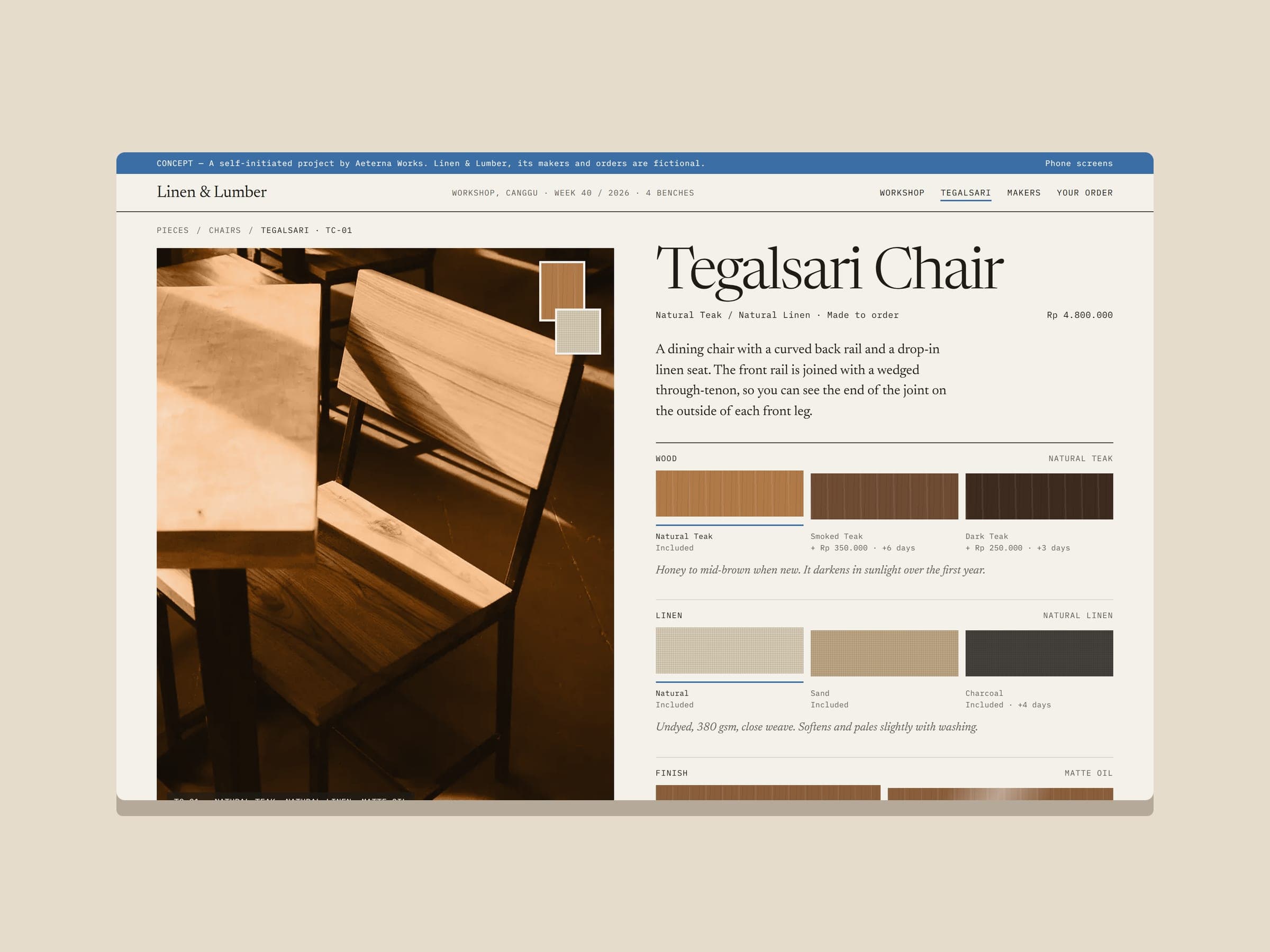
You can open the case study here: Linen & Lumber, Concept project.
A short checklist
Before you open an online store, check that you have:
Before you open an online store
- Customers who are ready to buy without a conversation
- Products with fixed sizes, prices and stock
- A payment provider that works in your country and currency
- Shipping rates, zones and a courier
- Photographs and descriptions for every product
- Written policies for returns, refunds and delivery
- Someone responsible for orders and questions every day
If several of these are missing, start with a catalogue and an easy enquiry, and grow into the shop.
From the studio
If you are deciding between a shop and a simpler site, tell us how you sell today. We will tell you honestly which one we think fits.